
How to Trade Nasdaq from India with a Professional Trading Environment
Why Indian Traders Are Exploring Global Markets
Today many Indian traders are not just looking at Nifty or Bank Nifty or Sensex or domestic equities for market observation. The movement in the global market has become an important part of the daily analysis as the global sentiment can influence the behaviour of the Indian market.
Nasdaq is one of the most closely followed markets in the world. You will see many of the best-known companies in technology, software, AI, semiconductors, EV, cloud computing and digital platforms.
This is why many traders look for how to trade Nasdaq from India. Their interest is generally linked to the exposure to the global market, movement of US stocks, evening hours of the market and understanding the behaviour of international markets.
However, you shouldn't consider Nasdaq trading as a simple way for the income. It is a fast-paced market where prices can react violently to company results, economic data, Federal Reserve comments, expectations about interest rates and global news.
For Indian traders, the answer is preparation. Before entering any global market traders should understand market structure, risk, legal avenues, platform rules and own fitness.
What Makes Nasdaq Different from Indian Markets?
Trading hours, price action, sector weightage, news flow, volatility is all different for Nasdaq as compared to Indian markets. Traders used to Indian exchanges might take some time to get their head around these differences.
The US market opens in the night according to Indian time. It can be good for some traders but also requires mental freshness, good routine and disciplined screen time.
Many Nasdaq stocks can be fast movers during the US market opening session. Minutes can see market direction change based on earnings results, inflation data, bond yield movement, technology sector news and Federal Reserve news.
An unprepared trader might have an emotional response to fast movement. That can lead to bad entries, over trading or ignoring risk limits.
So, trading Nasdaq from India should be done with research and caution. Market access is only one piece of the puzzle, responsible decision-making is more important.
Can Indian Traders Trade Nasdaq from India?
Indian residents can get involved in global markets through the permitted and regulated routes depending on the product, broker, platform, and rules. Traders should always check the current legal, tax and compliance requirements before moving money or trading on international markets.
Many of us may need to go through international brokerage platforms, allowed remittance paths, paperwork, currency conversion and tax filing to access the US markets. Do not disregard these points.
Traders should also be aware of the distinction between investing and active trading. Investing in US stocks is maybe more about long-term ownership. Active trading requires quicker decisions, more screen time and better risk control.
Before starting, traders should check if the platform they are using is legal, transparent and suitable for their needs. They should also be aware of charges, currency conversion costs, settlement rules and reporting obligations.
The message here is clear: understanding should precede access. A trader shouldn't just jump into Nasdaq because it looks like a nice market to be in.
Why a Professional Stock Market Environment Matters
Working from home is easy, but staying disciplined isn't always easy. There are so many distractions for traders: mobile notifications, opinions on social media, random tips, emotional reactions.
There is a delineation between casual screen time and serious market participation in a professional stock market environment. It gives traders a specific space to prepare, observe and review, so it can become a routine.
Such an environment may promote better habits before, during and after the trading session. Traders can build watchlists, track live movements, follow risk rules and review their decisions more thoroughly.
That’s not to say that a professional setup guarantees results. Trading always carries risk and there is no environment that can eliminate market uncertainty.
The advantage of a structured environment is that it can eliminate careless behaviour. It encourages a process for traders to follow, rather than acting on impulse.
What Is a Professional Trading Desk?
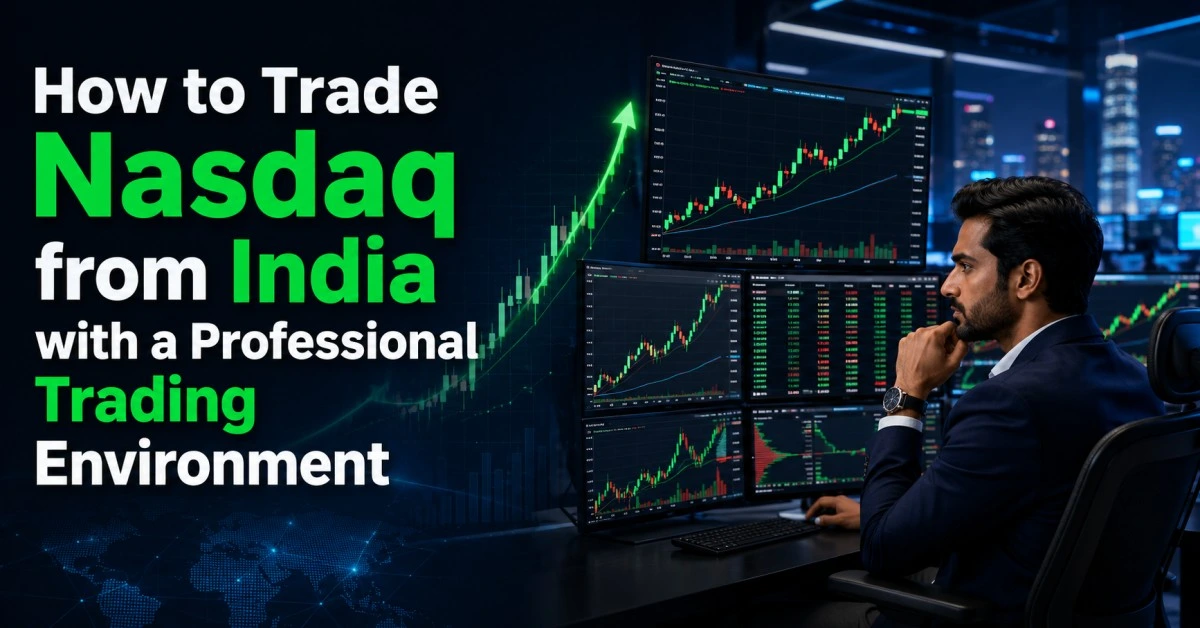
A professional trading desk is a well-defined environment, giving traders access to systems, screens, market data, risk rules and a focused trading environment.
This is not just about multi-monitor setups or a fancy office. A real trading desk supports the preparation, discipline of execution, observation of the markets, and review of the session.
Live Nasdaq Trading Setup for US Market Traders . Stable internet connection . Organized screens . Charting tools . Watchlists . News tracking . Risk monitoring .
The set-up should also have clearly defined rules. A trader should know the reason why he/she has entered a trade, the risk limit, the exit plan, and the conditions to avoid trading before they enter a trade.
Advanced infrastructure can be risky, too. Without rules. An overtrader may increase position size, chase movement or ignore losses.
What Should Traders Check Before Choosing a Trading Desk?
However, many traders look for the best trading desk in India. They need to consider the structure and transparency and not get swayed away by promotional claims.
The trading environment should be responsible and convey risk clearly. It should not guarantee profit, payout, employment, salary, funding approval, course outcome, trading income or success.
Traders need to find out if the setup is built on discipline, market preparation, risk control and realistic expectations.
They should also consider whether the environment is appropriate for their level of experience. The needs of a beginner and an experienced trader can differ in terms of support and exposure.
A good trading desk should be able to help traders think more systematically. It should support planning, controlled execution, risk awareness and improvement through review.
Trading Infrastructure for Serious Traders
Trading infrastructure is an important part of participating in live markets. Many traders concentrate only on strategy, but execution quality and system reliability are important as well.
A strong setup is the base of the whole trading process. Before the session, traders need to prepare watchlists, key levels and possible news triggers.
You need clear charts, stable connectivity, live market data and risk monitoring during market hours. Then they have to go over trades after the session and look for areas to improve.
For Nasdaq, this is even more important because the market can move fast. A delay in decision making or a weak system can lead to unnecessary stress.
A serious trader needs more than just motivation. “Trading is a structured activity and requires discipline and the ability to keep your cool during uncertain times.
| Trading Factor | Why It Matters | What Traders Should Look For |
| Internet and Backup | Fast markets require stable connectivity. | High-speed internet, backup connection, and power support. |
| Market Screens | Traders need clear visibility of price movement. | Organized charts, watchlists, and index tracking. |
| Risk Rules | Volatility can increase losses quickly. | Stop-loss discipline, daily risk limits, and position sizing. |
| Trading Environment | Distractions can affect decisions. | Focused workspace and serious market culture. |
| Review Process | Improvement comes from studying decisions. | Trade journal, session review, and performance tracking. |
| Realistic Communication | Traders should avoid false expectations. | Clear risk awareness and no guaranteed claims. |
Is Nasdaq Trading Suitable for Every Trader?
“Not every trader is suited to trading on Nasdaq. If a trader does not understand stop-loss, position sizing, order types, volatility and risk management, they should not jump into active trading.
Fast movement may be attractive from outside but can be difficult to manage without experience. First, a trader must learn how to protect capital and manage losses.
Also, it is important to understand the difference between investing and trading. Trading involves faster decisions and more rigorous risk controls while investing generally means longer-term ownership.
Traders should check the legality of all channels, rules of the platform, tax laws, currency exchange, and their level of risk tolerance before participating in any global market.
A trader should never trade Nasdaq just because someone on the internet is showing profits. Social media tends to show the wins, but hide the losses, the pressure, the drawdowns, and the emotional rollercoaster.
How to Approach Nasdaq Trading Responsibly from India
A good place to start is with education and observation. Traders should first understand how Nasdaq works, and what factors influence US market movement.
They should watch how stocks react to earnings, economic data, comments from the Federal Reserve, bond yields and sector-specific news.
The next step is to develop a trading plan. This plan should define risk per trade, daily loss limit, preferred trading hours, watchlist selection, review process.
A trader should also know when to not trade. It’s just as important to avoid weak setups as it is to spot a strong opportunity.
Discipline over excitement. The market does not reward random behaviour and traders who ignore risk can lose heavily.
Common Mistakes Indian Traders Should Avoid
A common mistake that people make is to enter Nasdaq trades without knowing the US market calendar. Earnings dates, economic events and Federal Reserve meetings can cause sudden volatility.
Another mistake is that we think the same way for all markets. Indian and US markets can behave differently due to liquidity, sector weightage, institutional activity and news response.
Some traders also don't consider currency and cost factors. The overall result when trading or investing in international markets can be influenced by charges, exchange rates, remittance costs and taxation.
Another major concern is overtrading. Exciting but not all moves are a trading opportunity in fast moving stocks.
The biggest mistake to avoid is believing any guaranteed claims. There is no guarantee of fixed income, profit, payout, job, salary, or market success in any real world trading environment.
Why Structured Trading Helps Build Better Habits
A structured trading environment helps traders become more process driven. It encourages pre-session preparation and post-session review.
This is useful as many traders lose consistency due to emotional decisions. They may make trades without a clear rationale, or stay in losing trades for too long.
Traders are encouraged to follow the rules in the professional environment. They can pay attention to market behaviour instead of reacting to noise.
Structure alone does not guarantee profit. It just helps traders to be disciplined in their approach to the market and helps with better decision making.
This difference can be important for serious traders. Routine, review and risk awareness build good habits.
BearStreet and Professional Market Participation
BearStreet Research & Analysis Pvt. Ltd. is established for Traders who are looking for a structured and professional market environment.
BearStreet’s focus is on live market exposure, a disciplined trading culture, risk awareness and a serious setup for traders who want to approach markets responsibly.”
Bearstreet is a place where market action is treated with a structure for traders who want to join a professional trading desk in India.
It’s not about false promises. BearStreet does not guarantee profit, payout, job, salary, funding approval, course outcome, trading income or success.
The aim is to create a trading atmosphere of discipline.” Traders still need to be responsible for their own decisions, risk and suitability.
Important Disclaimer for Traders
Trading in stock markets like Nasdaq and other markets around the world involves risk. Prices can go up as well as down and losses are possible.
The article does not position BearStreet as a job guarantee platform, course result provider or income assurance model.
No trader should enter any trading environment expecting fixed income, guaranteed return, assured payout or guaranteed market success.
All traders should check all rules, understand all risks, follow all legal and regulatory guidelines and make decisions based on their own financial capacity and experience.
A professional environment can help you to be disciplined but it can’t take away the uncertainty of the market.
Check Your Eligibility with BearStreet
If you are serious about trading and want to move beyond the casual home trading environment BearStreet will provide you with a structured environment that focuses on discipline, risk awareness and live market participation.
This CTA does not guarantee any profit, funding, payout, job, salary or achievement. It is an invitation to explore a serious trading environment based on structure and responsible market behaviour.
If you’re a trader who likes risk and wants a more focused setup, BearStreet is a relevant place to look.
Final Thoughts
Trading Nasdaq from India is an interesting area to explore for traders who wish to learn about the exposure of global markets but it needs to be approached with caution.
Markets can move fast, they can be volatile, and they can be sensitive to events around the world. Traders need to be prepared, disciplined, have risk control and the right environment.
A professional trading setup can help traders stay focused and organized, but it cannot guarantee results.
The right approach is respect risk, avoid unrealistic expectations and focus on process.”
So, for Indian traders seeking a structured live market environment, BearStreet provides a serious direction to explore with discipline and responsibility.
FAQs
1. How can I trade Nasdaq from India?
Indian traders can explore Nasdaq market access through permitted and regulated routes, depending on the broker, platform, product type, documentation, and applicable rules. Before starting, traders should verify legal access, charges, currency conversion, taxation, and risk suitability.
2. Is Nasdaq trading from India legal?
Indian residents should use only permitted and compliant routes for global market participation. Rules may vary based on the platform, product, remittance route, and regulatory guidelines, so traders should check updated information from official or regulated sources before trading.
3. What is a professional trading desk?
A professional trading desk is a structured trading environment with systems, screens, market data access, risk rules, and a focused setup. It helps traders approach live markets with more discipline and preparation.
4. Why do traders need a live Nasdaq trading setup?
A live Nasdaq trading setup helps traders observe price movement, charts, watchlists, market news, and risk levels during US market hours. It supports better decision-making, but it does not guarantee profit or success.
5. Is Nasdaq trading suitable for beginners?
Nasdaq trading may not be suitable for complete beginners because the market can be fast and volatile. Traders should first understand stop-loss, position sizing, order types, volatility, risk management, and platform rules.
6. What should I check before choosing a trading desk in India?
Traders should check transparency, risk rules, infrastructure, market setup, review process, and realistic communication. A responsible trading desk should not promise profit, payout, job, salary, funding approval, course outcome, or guaranteed success.
7. What infrastructure is useful for serious traders?
Useful trading infrastructure may include stable internet, backup connection, organized screens, charting tools, live market data, risk monitoring, watchlists, and a trade review process.
8. Can a professional trading environment improve trading discipline?
A structured environment may help traders stay focused, follow rules, and review decisions more carefully. However, it cannot remove market risk or guarantee positive results.
9. Does BearStreet guarantee profit or funding approval?
No. BearStreet does not guarantee profit, payout, funding approval, job, salary, course outcome, trading income, or success. Its focus is on a structured professional trading environment and responsible market participation.
10. Who should consider BearStreet?
BearStreet may be relevant for serious traders who want a structured market environment, live market exposure, disciplined trading culture, and risk-aware participation. Traders should check suitability based on their experience, mindset, and risk capacity.