

Funded Prop Firms Explained in Simple Terms: How Performance-Based Capital Is Changing Modern Tradings Explained in Simple Terms: How Performance-Based Capital Is Changing Modern Trading
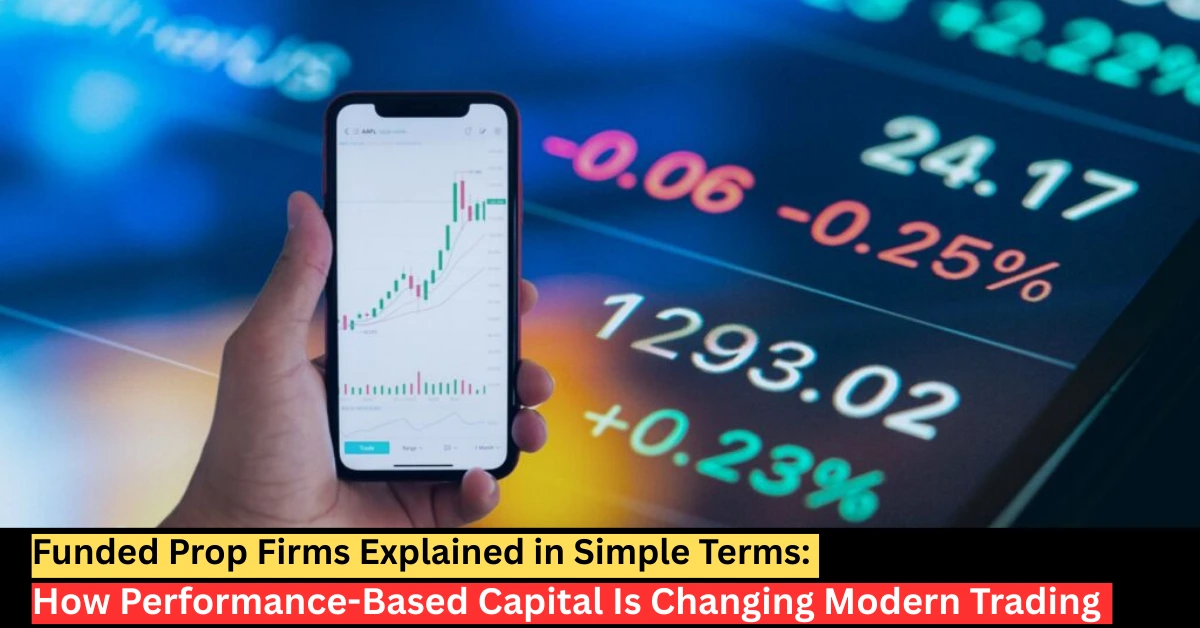
The professional trading landscape has evolved dramatically in recent years, largely driven by the rise of funded prop firms. These proprietary trading firms provide traders with access to company capital based on performance rather than personal wealth. Instead of risking their own savings, qualified traders operate funded accounts after passing structured evaluations that test consistency, profitability, and risk discipline.
This shift has created a professional pathway for individuals who possess trading skills but lack large starting capital. As markets become more competitive and volatile, firms increasingly prioritize traders who demonstrate controlled risk behavior rather than short-term profit spikes. This is why search interest continues to rise for terms such as funded prop firms, prop trading firm India, and performance-based trading programs.
At their core, funded prop firms function as capital allocators. Their goal is not to sell trading dreams but to identify individuals who can execute strategies responsibly under pressure. Traders earn a share of profits, while firms benefit from disciplined performance — a model closely aligned with institutional trading desks.
Who Can Join a Prop Trading Firm in India and Globally
The modern proprietary trading model is no longer restricted to financial hubs or large institutions. Traders from India, Asia, Europe, and beyond can participate remotely through online funding platforms. Anyone with a structured trading approach, risk management discipline, and consistent performance metrics can qualify.
For those specifically seeking a prop trading firm India can access, global firms have removed geographical barriers through cloud-based platforms and standardized evaluation systems. While traditional prop desks in India typically employ traders directly, funded account models now allow independent traders to participate professionally without relocation.
What matters most today is not where a trader lives, but how they trade. Firms evaluate decision-making under risk, emotional control, and long-term consistency — skills that transcend borders.
Why Trading Technical Analysis Drives Consistent Prop Firm Performance
Professional traders rely heavily on trading technical analysis because it offers objective, repeatable frameworks for decision-making. Rather than reacting emotionally to price movement or news events, technical analysis uses historical data to assess probability.
Through price structure, trend identification, momentum indicators, and volatility analysis, traders can anticipate high-probability setups and manage risk efficiently. Tools such as moving averages reveal trend direction, while support and resistance zones highlight key decision areas where price historically reacts. Indicators like RSI and MACD help assess momentum strength and potential reversals.
In funded environments where drawdown limits are strictly enforced, emotional trading quickly leads to disqualification. Technical analysis provides the discipline needed to remain systematic. Successful prop traders rarely chase markets. Instead, they wait for well-defined setups that align with their trading plan.
Over time, consistent technical execution — rather than sporadic big wins — is what prop firms reward and scale.
How Professional Traders Use Day Trading Software to Maintain Precision
Consistent trading performance is not possible without reliable market infrastructure. High-quality day trading software allows traders to analyze markets in real time, execute trades efficiently, and monitor risk exposure accurately.
Many professional traders rely on TradingView for technical analysis due to its clean interface, advanced indicators, and multi-timeframe charting capabilities. It enables traders to structure strategies visually and identify patterns with precision.
For execution and automation, MetaTrader 5 remains an industry standard across forex and derivatives markets. Its support for algorithmic strategies, custom indicators, and professional risk tools makes it highly suitable for funded trading environments.
Within the Indian market ecosystem, Zerodha Kite is widely used for equity and derivatives trading due to its reliability, fast execution, and regulatory integration.
The table below highlights commonly used professional trading platforms and their strengths:
| Trading Platform | Core Function | Market Coverage | Professional Advantage |
| TradingView | Technical analysis & charting | Stocks, forex, crypto, futures | Advanced indicators, strategy visualization |
| MetaTrader 5 | Trade execution & automation | Forex, CFDs, futures | Algorithmic trading, customization |
| Zerodha Kite | Indian market trading | NSE, BSE, derivatives | Low latency, real-time data |
| ProRealTime | Advanced analytics | Global markets | Precision charting & backtesting |
Where Traders Look for Prop Firms Near Them in the Digital Era
The phrase prop firms near me no longer strictly refers to physical office locations. In today’s digital trading environment, most funded firms operate entirely online. Traders are searching for credible, transparent platforms that provide structured evaluations, clear risk rules, and reliable payouts.
The location of the firm has become far less important than its trading conditions, capital scalability, and reputation. Traders now evaluate funding programs based on risk parameters, performance metrics, and support systems rather than geographic proximity.
This global accessibility has expanded opportunity while maintaining professional trading standards once reserved for institutional desks.
When Does Funded Prop Trading Make Sense for a Trader
Funded trading becomes appropriate when a trader has moved beyond random speculation and developed a repeatable strategy supported by risk management. Traders who consistently apply technical frameworks, limit losses, and maintain emotional discipline are well positioned for proprietary funding.
It is not designed for individuals seeking quick profits or risk-free income. Markets remain inherently uncertain. Funded accounts simply provide capital efficiency — not guaranteed success.
For disciplined traders, however, structured proprietary environments may offer capital scalability opportunities for traders who demonstrate consistent performance and disciplined risk management.
How Risk Management Sustains Long-Term Prop Trading Success
Risk management is the cornerstone of every professional trading operation. Funded prop firms enforce strict drawdown limits, daily loss caps, and position sizing rules to protect capital and ensure trader discipline.
Professional traders typically risk a small percentage per trade, maintain positive risk-to-reward ratios, and avoid emotional overtrading during volatile periods. These controls preserve capital during losing streaks and allow profits to compound during favorable market conditions.
This focus on controlled exposure — rather than aggressive profit chasing — is what separates professional trading from retail speculation.
A Professional View of BearStreet’s Trading Environment
Within the evolving proprietary trading landscape, BearStreet offers a structured ecosystem built around performance accountability and disciplined risk frameworks. Rather than promoting unrealistic outcomes, BearStreet emphasizes consistency, transparent evaluations, and long-term skill development.
Its approach reflects institutional trading principles where traders progress through measurable results rather than short-term profit bursts. By focusing on technical discipline, capital protection, and performance improvement, BearStreet creates an environment designed for sustainable trading growth.
The Long-Term Value of Funded Prop Trading Models
Funded trading provides several strategic advantages. Qualified traders who successfully meet defined evaluation criteria may become eligible to trade with allocated firm capital under structured risk rules. Professional risk controls improve emotional stability and performance consistency. Profit-sharing models allow income scalability based on skill.
Equally important, traders develop institutional-level habits that enhance long-term market adaptability. Over time, disciplined frameworks significantly outperform impulsive trading behavior.
However, funded trading remains a performance-based profession. Capital access must be matched with skill, patience, and continuous improvement.
Conclusion: Building a Professional Trading Path Forward
The rise of funded prop firms has transformed trading from a capital-limited pursuit into a performance-driven profession. By mastering trading technical analysis, leveraging professional day trading software, and operating within structured risk environments, traders can significantly improve consistency and scalability.
For those seeking a disciplined, transparent, and professional pathway into funded trading, BearStreet offers a realistic ecosystem focused on long-term performance rather than hype.
Take the Next Step with BearStreet
If you are serious about developing a professional trading approach grounded in discipline, risk control, and measurable progress, now is the time to explore BearStreet’s structured evaluation and performance-based trading framework.
Capital allocation is subject to defined evaluation criteria, risk policies, and ongoing performance standards. Trading involves risk, and past performance does not guarantee future results.
Frequently Asked Questions About Funded Prop Firms
1. What are funded prop firms?
Funded prop firms are proprietary trading companies that allocate capital to traders who meet defined performance criteria. Traders typically go through an evaluation process that assesses profitability, risk control, and consistency before becoming eligible to trade firm capital under structured rules.
2. How do funded prop firms work?
Funded prop firms operate through performance-based evaluation programs. Traders are assessed based on predefined profit targets, maximum drawdown limits, and risk management standards. Those who meet the criteria may qualify to trade with allocated capital under ongoing performance requirements.
3. Are funded prop firms available in India?
Yes, many proprietary trading programs are accessible online, allowing traders in India to participate remotely. Eligibility depends on meeting evaluation standards and complying with applicable regulatory and platform requirements.
4. Do funded prop firms guarantee profits?
No. Trading involves market risk, and no proprietary trading structure guarantees profits. Capital allocation is performance-based and subject to defined risk policies and ongoing evaluation standards.
5. What is the difference between retail trading and funded prop trading?
Retail trading involves using personal capital without institutional risk oversight. Funded prop trading operates within structured risk limits, including daily loss caps and overall drawdown controls, with performance accountability built into the framework.
6. How does a trader qualify for a funded trading account?
Qualification typically requires passing an evaluation phase that measures consistency, drawdown management, and disciplined execution. Each firm defines its own performance standards and risk parameters.
7. What risk management rules do funded prop firms enforce?
Most proprietary trading programs enforce maximum daily loss limits, total drawdown thresholds, and position sizing rules. These controls are designed to protect capital and promote disciplined trading behavior.
8. What markets can traders access through funded prop firms?
Depending on the firm’s structure, traders may access forex, equities, indices, futures, or commodities markets. Market availability varies by platform and jurisdiction.
9. Is funded prop trading suitable for beginners?
Funded trading models are generally more suitable for traders who already have a repeatable strategy and consistent risk management approach. Evaluation environments require discipline and structured execution.
10. What should traders consider before choosing a prop trading firm?
Traders should review evaluation criteria, risk rules, profit-sharing structure, payout transparency, platform reliability, and compliance standards before participating in any proprietary trading program.