
Nasdaq Today: Understanding the Index, the Futures, and What's Actually Moving Them
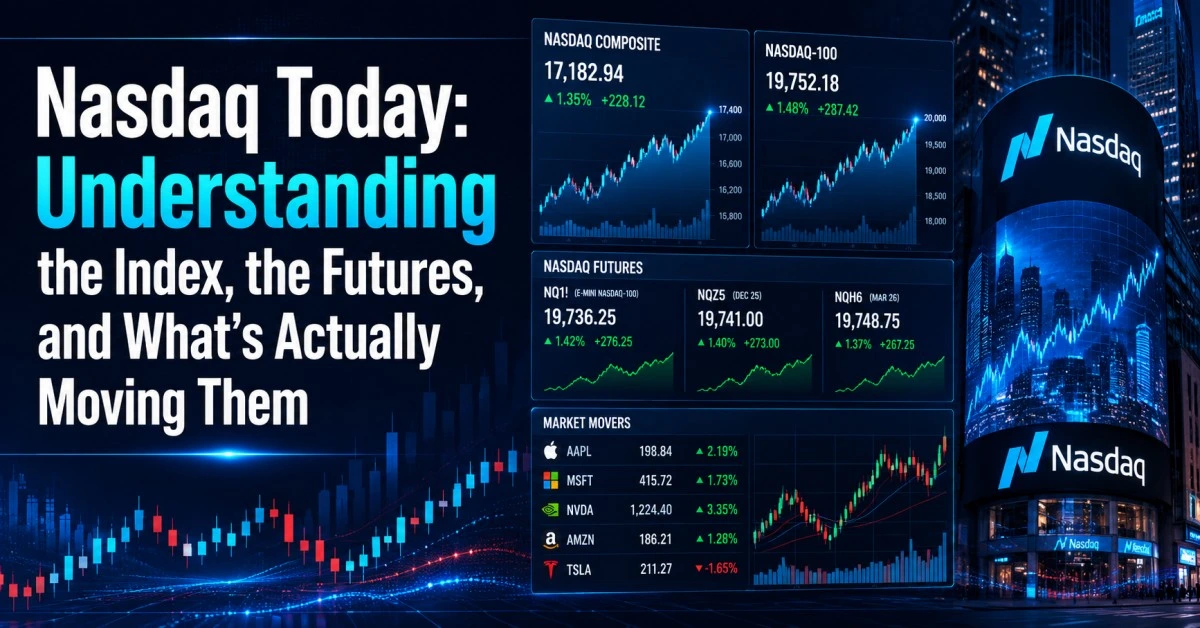
If you've typed "Nasdaq today" or "Nasdaq futures live" into Google this week, you're probably not looking for a textbook definition. You want to know why the index moved overnight and whether that's likely to carry into the next few hours of trading. Fair enough — that's the same thing most people checking this stuff actually want to know.
Here's the honest answer, though: the Nasdaq almost never moves for just one reason. In the last few weeks alone, oil prices, a Fed under new leadership, and earnings out of a handful of giant tech companies have all been pulling on the index — sometimes all in the same session. So instead of just throwing numbers at you, let's actually walk through what's going on: how the Composite and the Nasdaq-100 differ, what the data is showing right now, how futures fit into the picture, and how to read all of this without getting whipped around by every headline.
What Is "the Nasdaq," Really?
People throw around "the Nasdaq" pretty loosely, and that's part of the confusion. There isn't just one Nasdaq index — there are a few, and they don't always move together.
The Nasdaq Composite is the big one. It tracks pretty much every common stock listed on the Nasdaq exchange — thousands of companies, every sector, every size, from massive household names down to tiny ones you've never heard of. The Nasdaq-100, on the other hand, is much narrower. It only includes the 100 largest non-financial companies on the exchange, weighted by market cap. Banks and financial firms are deliberately left out, which is a big reason the Nasdaq-100 ends up so heavily skewed toward tech, chips, and big internet names.
Why does this matter to you? Because the two can tell completely different stories on the same day. The Composite reflects what's happening across thousands of companies. The Nasdaq-100 is really a bet on a much smaller, more concentrated group. So when someone says "the Nasdaq fell today," it's worth a second to ask — which one are they actually talking about?
So What's Actually Happening Right Now?
In the most recent session, the Nasdaq Composite sat in the mid-26,000s after dropping around 1% — and interestingly, that happened on the same day the Dow hit a fresh record high. That kind of split is worth noticing. Wall Street was mixed as hopes faded for a quick reopening of the Strait of Hormuz, and traders started turning their attention to the Fed's upcoming policy meeting. Two stories, but together they explain a lot: growth-heavy Nasdaq names lagged while the more old-school, industrial side of the market (which the Dow leans toward) caught a bid.
Step back even further and the Composite's 52-week range runs from around 19,335 up to just above 27,190. That's a huge spread for a single year. It tells you how much repricing has been happening — around AI spending, where rates are headed, energy policy, trade tensions, you name it. None of this has been calm. The Nasdaq tends to move in sharp bursts tied to specific news, not slow, steady drifts. So if you're just glancing at "Nasdaq today" as one number, you're missing most of the actual story.
Why People Watch Nasdaq Futures Around the Clock
Nasdaq futures — usually the E-mini or Micro E-mini Nasdaq-100 contracts — exist because the market doesn't actually go quiet just because the stock exchange closed for the day. These contracts trade almost 24 hours, which is exactly why "Nasdaq futures live" searches spike overnight: someone in Tokyo, London, or Dubai wants a read on sentiment hours before the New York open even happens.
Here's a real example of why that's useful. Over a weekend, news broke about a ceasefire and de-escalation deal tied to the Middle East. By the time futures opened for the new trading week, Nasdaq-100 E-mini futures had already jumped close to 2% — basically signaling a sharply higher open well before regular trading even started. Anyone watching futures overnight had hours to think through what they wanted to do. Anyone who waited to check the news the next morning was reacting to something that had already played out.
But don't treat futures as some kind of crystal ball. Around that same stretch, plenty of technical commentary on Nasdaq futures flagged oversold conditions tied to a recent inflation report — even while the broader headlines were turning more upbeat. Futures markets are digesting macro news and pure chart-based positioning at the same time, and those two forces don't always agree within the same 24 hours.
f you've ever found yourself trying to connect an overnight futures move to what you're actually seeing on your screen the next morning, that's a pretty common frustration — and it's part of why BearStreet exists. It pulls Nasdaq futures, index levels, and the stock moves behind them into one place that updates continuously, instead of you bouncing between five different tabs trying to piece it together yourself. See how BearStreet tracks Nasdaq futures in real time →
Composite vs. Nasdaq-100, Side by Side
| Feature | Nasdaq Composite (IXIC) | Nasdaq-100 (NDX) |
| Number of companies | Over 3,000 | 100 largest non-financial companies |
| Sector spread | Broad — every sector | Concentrated — mostly tech, chips, internet |
| Financial companies | Included | Excluded by design |
| What it's good for | Reading overall market breadth | Tracking large-cap growth and tech sentiment |
| How people typically follow it | Index quotes, broad commentary | QQQ ETF, Nasdaq-100 futures, options |
Next time a headline just says "the Nasdaq fell" without specifying which one, it's genuinely worth a quick check. Composite weakness and Nasdaq-100 weakness aren't always the same story, especially when the bigger tech names and the smaller companies are moving in opposite directions.
Why a Handful of Stocks Punch Way Above Their Weight
Because the Nasdaq-100 is weighted by market cap, a small number of companies end up driving most of its movement. Just seven companies make up over half the index's total weight, and almost all of them are tech names. So a single earnings call from one of those companies can swing the entire index — even if the other 90-something companies in there are barely moving.
This cuts both ways. When AI infrastructure or chip companies post strong numbers, the index can rally even if the rest of the market is shrugging. When questions pop up about whether all that AI spending is sustainable, or bond yields spike unexpectedly, those same few stocks can drag everything down together. So next time you see a big move in the headline number, it's worth remembering — it's probably a story about a handful of specific companies, not the whole market suddenly changing its mind.
Why Oil and the Fed Keep Showing Up in Tech-Stock Headlines
It might seem strange that a tech-heavy index cares so much about oil prices and interest rates, but the link is pretty direct once you trace it through. Oil shocks push inflation expectations around, inflation expectations move bond yields, and bond yields hit growth stocks especially hard — because more of their expected profits sit further out in the future, and those future profits get discounted more heavily when rates climb. That's the whole reason a Strait of Hormuz headline and a Fed meeting ended up sitting next to each other as the two biggest stories moving the Nasdaq in the same week. If you're following this market closely, you basically can't ignore energy news and Fed commentary — tech-sector news alone only gets you half the picture.
Reading This Market Without Pretending to Predict It
To be clear — none of this is about predicting where the Nasdaq goes next. Nobody can do that reliably, and anyone telling you otherwise is selling something. What this kind of context actually gives you is a better way to read the daily noise: knowing whether a story is about the Composite or the Nasdaq-100, understanding that futures give you an early read (not a sure thing), and remembering that a handful of big companies often explain more of a move than the headline lets on. That doesn't make the uncertainty go away. It just makes the daily wave of "Nasdaq today" headlines a lot easier to actually understand.
Want a Clearer View of All This? Check Out BearStreet
If you're tired of piecing together Nasdaq futures, index moves, and the stocks behind them from ten different sources every morning, that's exactly the gap BearStreet is built for. It brings all of that into one continuously updated view, so you're starting your day with context instead of catching up on it. Check out BearStreet →
Frequently Asked Questions About the Nasdaq
Is the Nasdaq the same as the Nasdaq-100?
No. The Nasdaq Composite includes essentially every common stock listed on the Nasdaq exchange — thousands of companies across every sector. The Nasdaq-100 is a smaller, more concentrated index made up of just the 100 largest non-financial companies on Nasdaq. They often move in the same direction, but not always by the same amount, and sometimes not in the same direction at all.
Why does the Nasdaq move so much compared to other indexes?
It's largely the concentration. Because the Nasdaq-100 is weighted by market cap and dominated by a handful of large tech and semiconductor companies, strong moves in just a few stocks can swing the whole index. The Dow and S&P 500 spread their weight across more sectors, including financials and industrials, which tends to smooth things out a bit more.
What time do Nasdaq futures start trading?
Nasdaq futures, like the E-mini and Micro E-mini Nasdaq-100 contracts on CME Group, trade nearly around the clock on weekdays, with only short daily breaks. That's why "Nasdaq futures live" data is available well before the 9:30 a.m. ET stock market open.
Do Nasdaq futures actually predict how the day will go?
They give an early read on sentiment, not a guarantee. Futures react to overnight news and economic data, but they also reflect technical positioning that can shift once regular trading volume kicks in. It's common for futures to point one way before the open and for the actual session to behave differently.
Why did the Nasdaq drop while the Dow hit a record high?
This kind of split usually comes down to what's driving each index. The Dow leans more industrial and value-oriented, so it can benefit from things like falling oil prices or de-escalating geopolitical risk. The Nasdaq is more sensitive to interest rate expectations, since growth stocks get valued more heavily on future earnings, which are discounted more as rates rise.
How many companies make up the Nasdaq-100?
The Nasdaq-100 includes 100 of the largest non-financial companies listed on Nasdaq, though there are sometimes 101 tickers in practice because a few companies, like Alphabet, have more than one share class included.
Why are financial companies excluded from the Nasdaq-100?
That's simply how the index was designed from the start — it's meant to track non-financial, large-cap innovation and growth companies. Banks, insurers, and other financial firms are deliberately left out, which is part of why the index leans so heavily toward tech.
What's the difference between trading the Nasdaq Composite and the Nasdaq-100?
Most retail traders don't actually trade the Composite directly — there's no widely traded futures contract or ETF built specifically around it. When people say they're "trading the Nasdaq," they usually mean Nasdaq-100 exposure through something like the QQQ ETF or Nasdaq-100 futures contracts.
Why do oil prices affect Nasdaq stocks?
It's an indirect but real connection. Oil price spikes can push inflation expectations higher, which pushes bond yields up, and higher yields make future earnings worth less in today's dollars — which hits growth-heavy Nasdaq companies harder than more established, steady-earnings businesses.
Is it possible to predict where the Nasdaq will go next?
Not reliably, no. Markets respond to a mix of economic data, company earnings, geopolitical events, and shifting investor sentiment, often all at once. The goal of following Nasdaq news closely isn't to predict the next move with certainty — it's to understand what's driving the current one so the daily headlines make more sense.
This article is for informational purposes only and isn't financial, investment, or trading advice. Markets carry real risk, and past price action doesn't predict what happens next.