
Why Are IT Stocks Falling Today? Infosys, TCS, HCL Tech Crash After Accenture's Warning
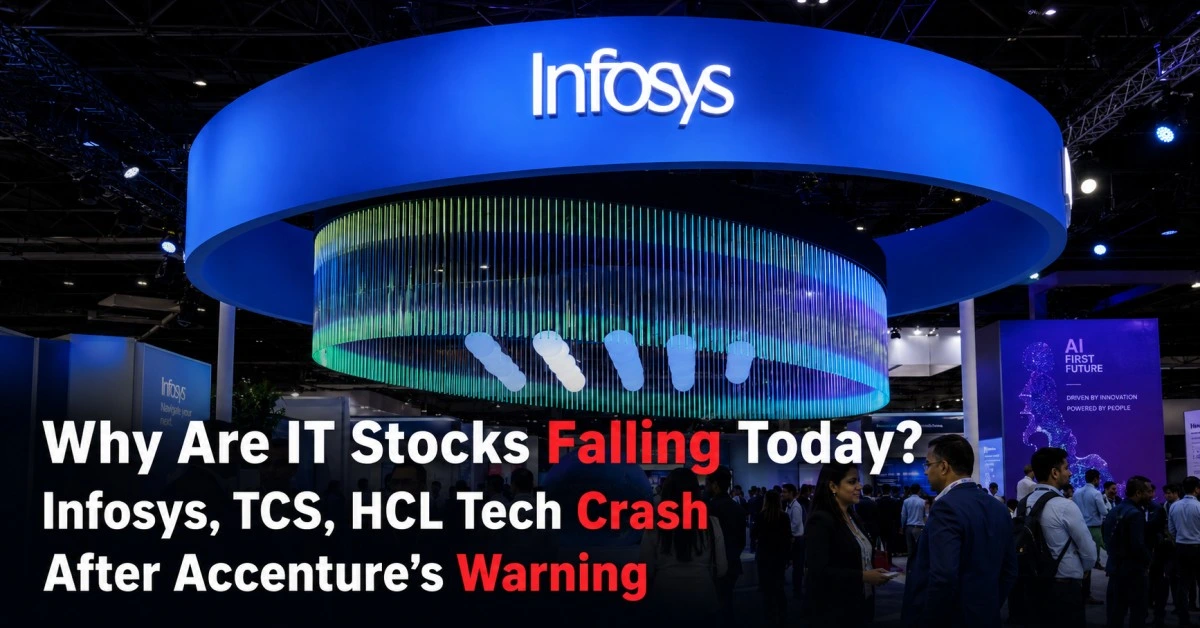
Markets opened to a rough morning on Friday, June 19. Within minutes of the bell, the Nifty IT index had shed more than six percent, and the damage spread fast — Infosys, TCS, HCL Technologies, Tech Mahindra and Mphasis were all deep in the red. If you've landed here after Googling "Infosys share price" or "why IT stocks are falling today," here's the short version: a guidance cut from Accenture, one of the world's biggest IT bellwethers, has spooked Dalal Street right when the sector had finally started to recover.
What actually happened to Infosys and IT stocks today
The trouble didn't start in India. It started a day earlier on Wall Street, when Accenture — the Dublin-headquartered consulting giant whose quarterly numbers are treated almost like an industry weather report — trimmed its revenue guidance for the financial year ending 2026-27. The company's reasoning: client demand is softening, and a chunk of that softness traces back to the ongoing West Asia crisis, which has made corporations more cautious about technology spending, particularly in sectors tied to energy, logistics, and global trade.
That news didn't wait for Indian markets to open. American Depositary Receipts of Infosys and Wipro got hit hard in Thursday's US session, with Infosys ADRs among the worst-performing South Asian tech names on a day when the rest of the Asian tech basket was mostly green. By the time Indian markets opened Friday, the selling pressure had already built up, and IT stocks gapped down right at the start.
Why does one Accenture warning move Infosys and TCS?
It's a fair question, and it comes up every time something like this happens. The short answer: Accenture, Infosys, TCS and HCL Technologies are all fishing in the same pond. They chase the same large enterprise clients across banking, retail, manufacturing and telecom in the US and Europe. So when Accenture says deals are slowing or clients are sitting on their hands, investors don't wait around to find out if Infosys and TCS will say the same thing in their own earnings calls — they sell first and ask questions later.
That's really the mechanism behind a guidance cut in Dublin wiping out billions of rupees in Bengaluru before lunch. It's sentiment getting ahead of the actual numbers, and more often than not, that gap closes once the Indian IT majors put out their own commentary.
How bad is the fall, really — and where does the sector stand?
Context helps here, because the IT pack wasn't exactly limping into this. It had been on a decent run. Here's how the picture looked heading into Friday versus what changed once Accenture's numbers landed:
| Metric | Recent Trend (Past Month) | Friday's Move (June 19) |
| Nifty IT Index | Up roughly 6-9% over the prior month, outperforming the broader Nifty 50 | Down more than 6% at the open, the worst-performing sectoral index of the day |
| Infosys | Gained nearly 9% Gained nearly 9% over the past month; fell about 3% in the prior session over the past month; fell about 3% in the prior session | Among the sharpest decliners alongside TCS and HCL Tech |
| TCS, HCL Tech, Tech Mahindra, Mphasis | Broad-based recovery across the IT basket | All under heavy selling pressure in early trade |
| Underlying Trigger | Optimism around AI-led deal pipelines and rate-cut hopes | Accenture's FY27 guidance cut citing West Asia-linked demand caution |
| Nifty 50 (Broader Market) | Largely range-bound | Comparatively resilient, with IT the standout laggard |
Put simply, this drop isn't happening in a vacuum — it's eating into a rally that had only just gotten going, which is part of why the reaction feels so sharp this morning.
(Readers curious about how proprietary trading floors actually screen candidates for this kind of work can take a look at BearStreet's eligibility criteria for context.)
Is this a one-off shock, or does it point to something bigger?
Selloffs triggered by one company's comments, rather than a broad earnings miss across the sector, tend to be more about repricing risk than any real change in the underlying business. Neither Infosys nor TCS has given its own FY27 guidance yet, and most analysts would argue the long-term case for Indian IT — cloud migration, cybersecurity spend, the slow build-out of enterprise AI — hasn't gone anywhere, even on a day like this.
That said, the West Asia situation Accenture flagged isn't a one-day story. It's an ongoing risk, which means more choppiness in IT stocks is likely until Indian companies offer their own read on demand, probably around their July results. Days like today are a useful reminder of just how reactive markets can be to a single data point out of a single overseas company — and how often those moves partially unwind once more concrete information shows up.
Has this happened before?
If this morning feels familiar, it's because it is. Indian IT stocks have a long history of taking a beating whenever a global peer flags weakness, only to claw most of it back within a few sessions. A downgrade from a global brokerage, a soft quarter from a US competitor, a hawkish line out of the US Federal Reserve — and Infosys, TCS, Wipro and the rest get marked down fast, often before anyone has checked whether the read-through even applies to them.
The Nifty IT index itself has swung wildly through 2026. It hit a 52-week low in mid-May, staged a sharp two-session rally on AI-deal optimism, then gave a chunk of that back almost immediately on profit booking. A few weeks before that, the index cracked nearly five percent in a single session with no real company-specific trigger at all — just an unwind after a strong run-up. Today's drop matters, but single-day, sentiment-driven moves in this sector have repeatedly turned out to be noisy rather than predictive. The more useful signal usually shows up only once Infosys or TCS speaks for itself.
What investors actually look for in Infosys's own numbers
Since Accenture's commentary is really a proxy for what Infosys and TCS might say, it helps to know what the real tell will be once they do speak. Analysts tend to zero in on revenue growth guidance in constant currency terms, which strips out rupee noise; the size and pace of large deal wins, the best forward indicator of revenue two or three quarters out; and attrition and hiring trends, which hint at whether the company expects demand to pick up.
Infosys's board meets for Q1 results in the third week of July — the first real data point, rather than a read-through from an unrelated American company, that will show whether today's fear is justified or overdone. Until then, expect a fair amount of guessing dressed up as analysis, which is more or less what's driving the tape this morning.
A few things will decide whether this selloff keeps running or fades quickly. Watch for any informal word from Infosys or TCS leadership on demand trends — markets often calm down on one reassuring sentence. Watch how the Nasdaq and US tech ADRs trade in the coming sessions, since Indian IT has been tracking its American peers closely all year. And keep an eye on the West Asia situation itself, since that's the root cause Accenture pointed to — any sign of de-escalation there would likely ease the fear out of the sector.
None of that resolves overnight. Mornings like this tend to separate the people who understand what's moving the tape from the ones just watching a red number fall.
How professional day traders think about days like this
For most investors, a six percent gap-down is just a headline. For a professional day trader, it's a working session — built around order flow, volatility, and exactly the gap between sentiment and fundamentals described above. Telling the difference between an overreaction and a genuine shift takes practice, and that's really what proprietary trading desks exist to build. Delhi-based BearStreet is one such desk — trainees work alongside mentors on a supervised trading floor, learning to read these kinds of news-driven moves before sentiment settles down.
Worth being clear about what that is and isn't: BearStreet is a trader-training and proprietary trading floor, not a brokerage or investment platform. It isn't registered with or regulated by SEBI or any stock exchange, and it makes no promise of employment, income, or trading profits to anyone who joins. If you're curious whether you'd meet the basic criteria for this kind of program, BearStreet's eligibility form is available to look through directly.
This article reflects market developments as of the morning of June 19, 2026. It is intended for informational purposes only and does not constitute investment advice. Please consult a registered financial advisor before making investment decisions.