

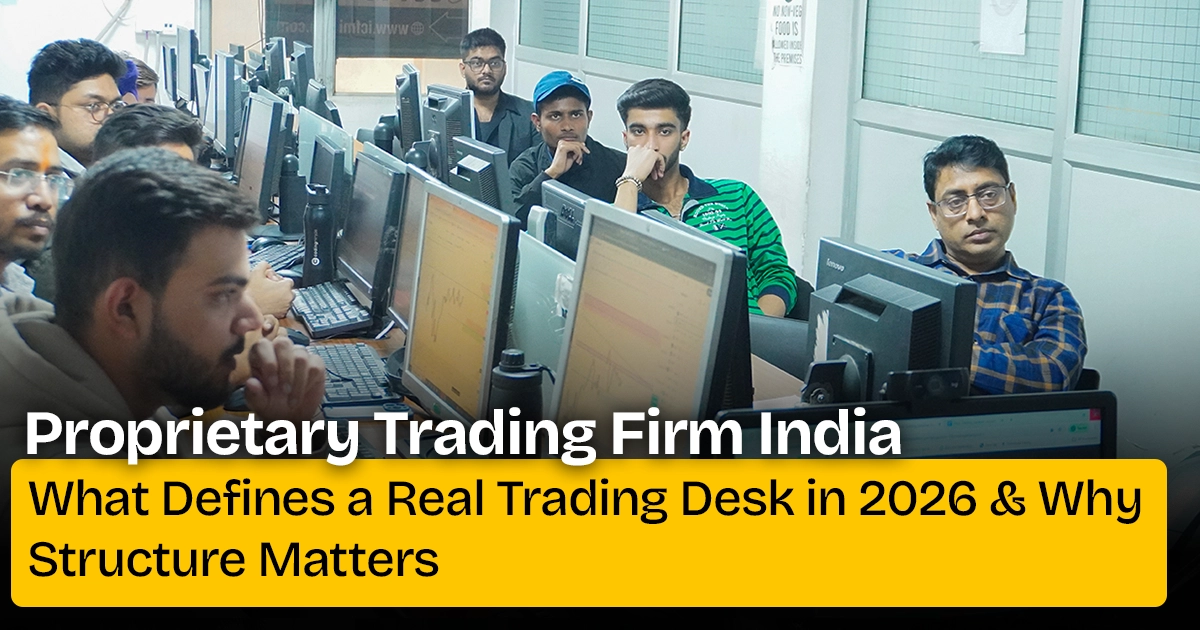
Proprietary Trading Firm India: What Defines a Real Trading Desk in 2026 & Why Structure Matters
Why Traders Are Rethinking How They Approach the Market
More and more traders in India have been questioning not only what they trade, but also how they trade. After times of volatility and unpredictable results, more and more people are realising that strategy alone doesn't always lead to good results in the market.
A lot of people who start trading on their own eventually look beyond charts and indicators. They start to look into whether a more structured environment can affect how decisions are made, how risks are managed, and how consistent everything is overall.
This change in thinking has made people more aware of the idea of a proprietary trading firm in India and the role of a professional trading desk. This is not a shortcut, but a different way to do business in the markets.
What Is a Proprietary Trading Firm in Practical Terms?
A proprietary trading firm is a structured place where trading happens according to set rules instead of letting each trader do whatever they want. In these kinds of places, decisions aren't made on the spur of the moment or in isolation; they are made within a system that values discipline over flexibility.
In a structured setup, there are limits on risk and execution. In independent trading, people are in charge of everything. These limits are meant to make things more consistent. Risk is predetermined, exposure is managed, and performance is evaluated over time rather than based on isolated results.
The difference is not about tools or access; it's about how behavior is shaped in a trading environment on a deeper level. Some setups focus on models that are based on simulations, while others are based on structured processes that happen in real time. It is important to understand this difference because it has a direct effect on how traders feel about stability in the long run.
Why the Search for Best Reflects a Change in Mindset
When traders start to look into structured environments, the meaning of "best" often changes. At first, people may pay more attention to things like the amount of capital or the requirements for entry. It's easy to compare these, but they don't always deal with the main problems of trading.
As you get more experience, you start to think about deeper things. Traders begin to wonder if the environment encourages disciplined decision-making, if risk is always handled well, and if performance is measured in a way that promotes stability.
This change in how people think is important. It shows that people are moving away from short-term expectations and toward a better understanding of how trading results change over time. The strategy includes the environment itself.
How a Professional Trading Desk Actually Functions
A professional trading desk operates with the assumption that consistency comes from structure and repeatability, not from isolated success. Every aspect of the environment is designed to reduce randomness and bring clarity to decision-making.
This method is based on risk management. Risk is set before any trade is made, so there is no need to react to market changes. This gives you a certain amount of control that helps keep things stable, even when the markets are unstable.
People also see performance in a different way. It is not measured by making money on trades from time to time, but by being able to stay disciplined in different market conditions. This changes the focus from results to behaviour, which is often a better sign of long-term sustainability.
It also becomes easier to see how markets work. Instead of just looking at price changes, people also look at things like liquidity, global effects, and how different markets work together. This gives us a better idea of how prices change over time.
Execution discipline brings all of this together. People expect decisions to follow a process, which makes emotions less important. This method tends to make a trader's mind more stable and consistent over time.
Why Location-Based Trading Setups Are Gaining Interest
There has also been a noticeable rise in interest in trading environments in certain areas, such as big cities like Delhi. This is part of a larger effort by traders to link what they know about theory to what they see in the real world.
But it's important to remember that the value of a trading desk doesn't just come from where it is. The framework, not the geography, of a structured environment defines it. The setup is still like independent trading, no matter where it is based, unless there are clear risk management and disciplined execution processes in place.
The growing interest in such locations simply indicates that traders are seeking proximity to structured environments, not just access to markets.
Understanding the Practical Advantages and Limitations
A structured trading environment can help make things clearer in places where independent trading often becomes unclear. It lowers uncertainty and encourages disciplined behaviour by defining risk and putting more emphasis on the process. This can help you make decisions more consistently over time.
These settings do have their own set of problems, though. Having set rules can make things less flexible, which is not good for people who like to have full control over how they trade. Also, consistency is expected, which puts a different kind of pressure on traders than trading on their own.
It's also important to know that not all setups have the same amount of structure. The effectiveness of any environment is contingent upon the clarity and maintenance of its frameworks.
Who Should Explore Structured Trading Environments
Not everyone can use structured trading environments. But they matter to people who have had inconsistent experiences and are trying to figure out why.
Traders who value discipline, set risk, and a process-driven approach often find it helpful to learn how these kinds of environments work. Even if you don't directly participate, learning about these frameworks can help you trade better on your own.
What Should Be Evaluated Before Considering Any Setup
Before looking into any structured trading setup, you should first learn about the underlying framework. It is important to look into how risk is managed, how performance is measured, and whether the setting makes it easier to make decisions that are consistent.
Clarity in these areas often gives a better view than just looking at the surface. The structure of the environment, not initial expectations, shapes the overall trading experience over time.
The Real Shift in How Trading Is Understood
The idea of structured trading environments in India is slowly changing. It is no longer just an alternative to independent trading; it is now seen as a completely different way of doing things that focuses on process, discipline, and controlled exposure.
This change shows that people know more about the markets. Traders are starting to realise that consistency doesn't just happen. Over time, the right environment and approach help it grow.
In that context, the focus is no longer just on finding opportunities; it's also on figuring out how to handle and approach those opportunities.
How to Evaluate Whether a Structured Trading Environment Is Right for You
Before you think about using a structured trading setup, you should think about whether it fits with how you handle risk, discipline, and making decisions. Instead of looking for quick results, many traders look into these frameworks to learn more about how professional trading environments work.
A structured environment usually works within set risk limits and follows a set process. It needs to be consistent over time and everyone needs to know how decisions are made within a framework. Taking a close look at these things can give you a better idea of what's going on than just looking at surface-level expectations.
Next Step: Review Eligibility and Understand the Structure
If you want to know how structured trading environments are actually set up, you might want to look at the eligibility criteria and operational frameworks in more detail.
For an informational perspective on how such environments are approached, you can explore and check eligibility with BearStreet Research & Analysis Pvt. Ltd. to understand whether this structured approach aligns with your trading perspective.
Note for Readers
This article is strictly informational and does not provide financial advice, recommendations, or any guarantee of trading outcomes.
FAQs: Proprietary Trading Firm India, Prop Trading Desk & How It Works (2026)
Why are more traders searching for prop firm India in 2026?
The rise in searches for prop firms in India is not just a short-term trend; it shows a change in how traders think. A lot of traders who used to only think about strategies are now realising that structure, discipline, and risk control have a big effect on what happens in the market. So, they are looking into how professional trading environments work and whether a more structured approach can help them be more consistent over time.
What actually defines the best prop trading firm India today?
The idea of the best prop trading firm in India is no longer just about how much money you have or how you get in. More experienced traders tend to look at how risk is managed, how performance is measured over time, and whether the environment makes it easy to stick to rules. When looking at any trading setup, the quality of the structure and consistency is often more important than how it looks on the surface.
How is a professional trading desk India different from normal trading?
A professional trading desk in India works within a set framework, where decisions are made based on a process rather than what each person wants to do. Before execution, risk is managed, and performance is judged on how consistent it is, not on how well it does in one instance. Normal independent trading, on the other hand, lets you be flexible, but it often doesn't have the structured discipline that keeps things stable over time.
Why are traders specifically searching for prop trading desk Delhi?
The search for a prop trading desk in Delhi shows that more and more people want to connect structured trading ideas with the real world. Delhi is a natural place to be interested in because more and more people are getting involved in financial markets there. But the location of a trading desk doesn't matter as much as how well it is organised and how disciplined its employees are.
Do proprietary trading firms in India guarantee profits or capital?
No, proprietary trading firms in India do not promise profits or results. There is always a risk when trading, and the results depend on how well you do, how disciplined you are, and what the market is like. Structured environments may help you handle risk better, but they don't get rid of uncertainty in the markets.
Is joining a prop firm India better than trading independently?
This is up to the person. Some traders like a structured environment where risk and execution are clear, while others like the freedom of trading on their own. The main difference is whether a trader values discipline that is based on a process or freedom to make decisions.
How do structured trading environments help improve consistency?
In structured environments, the main goals are to define risk, control exposure, and keep the decision-making process the same every time. This lessens the effects of emotional trading over time and helps make outcomes more stable. Most of the time, strategy alone doesn't lead to consistent trading. The environment in which decisions are made usually helps.
What should traders evaluate before choosing any prop trading setup?
Before thinking about any setup, it's important to know how risk is handled, how performance is measured, and whether the environment encourages disciplined execution. These factors give you a better idea than just comparing things on the surface and help you make better choices.
Is prop trading in India suitable for beginners in 2026?
It depends on how well the person understands risk and how well they can follow structured processes. Some beginners may benefit from exposure to disciplined environments, while others may require foundational knowledge of market behaviour prior to adapting to structured systems.
What is the future of proprietary trading firms in India?
As time goes on, proprietary trading firms in India will probably move toward environments that are more structured and process-driven, with a stronger focus on risk management and consistency. As traders learn more about how markets work, the focus will likely shift from short-term results to long-term stability and disciplined execution.