
Options Trading Explained: What It Is, How It Works, and How to Get Started in the Stock Market
I Wish Someone Had Told Me This Before I Started Trading
When I first came across options trading, I assumed it was something reserved for finance professionals with six monitors and Bloomberg terminals. What I discovered is that options are not nearly as mysterious as they seem — and once you understand the basics, they open up ways of engaging with the stock market that simply buying and holding cannot offer.
That said, I want to be upfront: this guide does not promise you will get rich. Markets do not work that way. What it does is walk you through how the stock market works, what stock options actually are, and how to approach them with clarity and discipline.
Let's Start with the Stock Market Itself
Before options make any sense, you need a solid feel for how the stock market works. At its core, it is a marketplace — highly regulated, very liquid — where people buy and sell small ownership stakes in publicly listed companies. When you buy shares of a company, you are genuinely becoming a part-owner. You benefit when the business does well and bear the downside when it does not.
Stock prices move for all sorts of reasons. A company's earnings, its growth trajectory, the quality of its leadership — these are the fundamentals that determine real long-term value. But in the short run, prices also get pushed around by investor sentiment, interest rate decisions, and global news. Knowing the difference between noise and signal is one of the most valuable skills you can develop.
If you are just getting started, the practical steps are simple: open a regulated brokerage account, finish your KYC, and begin with an amount you are comfortable losing while you learn. Early investing is as much about education as it is about returns.
What Exactly Is a Stock Option?
A stock option is a contract between two parties. The buyer pays a price — called the premium — in exchange for the right, but not the obligation, to buy or sell a specific stock at an agreed price (the strike price) before a set expiration date.
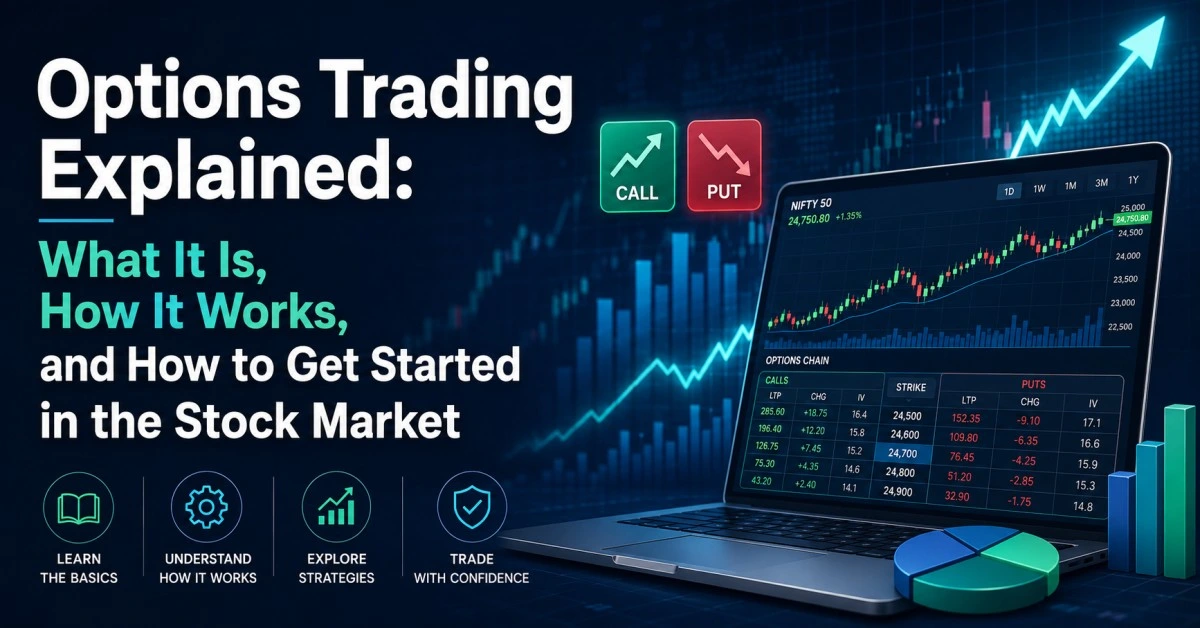
There are two kinds. A call option gives you the right to buy shares at the strike price. If you think a stock is heading higher, a call option lets you profit from that move while limiting your risk to the premium you paid. A put option gives you the right to sell shares at the strike price. If you think a stock is heading lower — or you own shares and want to protect yourself from a drop — a put option is your tool.
Here is something worth understanding early: options are not inherently risky instruments. They can be used aggressively by traders chasing big moves, or conservatively by investors protecting their portfolios. The risk level depends entirely on the strategy, not the contract type.
One thing you absolutely must get comfortable with is time decay. Every options contract has an expiration date, and as that date gets closer, the contract steadily loses value — even if the stock is moving in your favour but just not fast enough. This is called theta decay, and ignoring it is one of the most expensive lessons new options traders learn the hard way.
How to Actually Trade Options — Step by Step
You do not need a finance degree to start trading options. You need a process, and you need to stick to it.
The first step is forming a genuine view on the stock before you look at a single contract. Where do you think the price is going? Up, down, sideways? Over what time frame? If you cannot answer those questions clearly, you are not ready to enter a trade — and that is fine. Waiting for clarity is itself good trading discipline.
Once you have a thesis, you open the options chain — a table in your brokerage platform that shows all available contracts for a given stock, sorted by strike price and expiration. If a stock is trading at ₹500 and you genuinely believe it will reach ₹550 within the next month, a call option with a ₹520 strike expiring in roughly 30 days is a reasonable starting point. Your maximum possible loss is the premium. That is it.
Before you confirm the trade, check implied volatility — often shown as IV. When IV is high, the market is pricing in big expected moves, which inflates premiums. Buying options when IV is elevated means you are paying more, and you need a larger move to break even. Many experienced traders specifically avoid buying options during high-IV periods and look to sell them instead, collecting the inflated premium.
After you are in a trade, stay engaged. If it hits your target profit early, close it — do not get greedy. If it moves hard against you past the level where your original thesis no longer holds, exit. Making those decisions in advance, before emotion gets involved, is what keeps small losses from becoming large ones.
Where Do Options Fit Among Your Best Investment Options?
Options are one tool in a wider range of investment vehicles. Here is an honest comparison to help you think about where they sit.
| Investment Vehicle | Typical Historical Return | Risk Level | Liquidity | Best Suited For |
| Direct Stocks | 10–15% per year | Medium–High | High | Long-term wealth building |
| Options Trading | Varies widely | High | Very High | Active, strategy-driven investors |
| Equity Mutual Funds | 10–14% per year | Medium | Medium | Hands-off, long-term investors |
| Index Funds / ETFs | 10–13% per yea | Low–Medium | High | Beginners, passive investors |
| Fixed Deposits / Bonds | 6–8% per year | Low | Low | Capital preservation |
| Gold / Commodities | 6–10% per year | Medium | Medium | Portfolio diversification |
These figures are historical averages — not forecasts, not promises. Options in particular sit at the wide-variability end of the spectrum. Used well, they can meaningfully enhance returns. Used carelessly, they can wipe out the entire amount invested. The difference lies in knowledge, process, and honest self-assessment of your risk tolerance.
Stop Trading on Gut Feel — Start Trading on Data
BearStreet gives you live options analytics, real market insights, and a community of serious investors. Make decisions you can actually stand behind. Try BearStreet Free — No Credit Card Needed →
Three Options Strategies Worth Understanding
Most people start by simply buying calls or puts. That works fine as a starting point, but the deeper value of options becomes clear through a few more structured approaches.
The covered call is probably the most popular options strategy among everyday investors who already hold shares. You sell a call option against shares you own and collect the premium as income. If the stock stays flat or drifts up modestly, you keep the income. If it shoots up sharply past the strike, your shares get sold at the agreed price — still a profitable outcome, just with a ceiling on the upside. It is a sensible way to earn from a position you are already holding.
The protective put is essentially insurance for your portfolio. You pay a premium for the right to sell your shares at the strike price regardless of how far the stock falls. This is particularly useful heading into periods of uncertainty — major earnings, policy decisions, or anything that could move a stock sharply in either direction.
Vertical spreads — buying one option and selling another at a different strike in the same expiration — let you take a directional view for less upfront cost than buying a single option outright. You define both your maximum gain and your maximum loss before the trade begins. For investors who want structured exposure without open-ended downside, spreads are often a more considered choice than a naked long position.
None of these remove risk entirely. What they do is replace vague exposure with clearly understood parameters — and that alone puts you ahead of most people who enter options markets without a plan.
The Three Habits That Separate Consistent Investors from the Rest
Markets are humbling. Even experienced investors have losing stretches. What separates those who build genuine long-term results from those who wash out is not talent — it is discipline.
Keeping risk per trade small — no more than 2–5% of total capital on any single position — means a bad run does not end your ability to keep going. Protecting capital is not passive; it is your most active competitive edge.
A trading journal sounds tedious until you realise what it shows you. Writing down why you entered, what you expected, and what actually happened reveals patterns in your decision-making that no book can. Over time, you start to see your own blind spots clearly.
Then there is emotion. Losses make you want to recover fast. Wins make you feel untouchable. Both impulses lead to poor decisions. The investors who build real results over years are almost always those who learned to follow their process regardless of how they felt in the moment.
Your Edge Starts with Better Information
BearStreet brings live options data, strategy tools, and market analysis together in one place — so you spend less time guessing and more time investing with confidence. Join BearStreet Today — It's Free to Start →
Frequently Asked Questions
How much money do I need to start trading options in India?
You can technically start with ₹15,000–₹25,000, but having ₹50,000 or more gives you more room to spread risk across a few positions and avoid over-concentrating on a single trade.
Is options trading for beginners?
With the right groundwork, yes. Most experienced options traders recommend starting with paper trading — simulated trades with no real money — to get comfortable with how contracts behave before real capital is at stake.
Can options actually reduce my portfolio risk?
Absolutely. Protective puts and covered calls are used specifically for risk management, not just speculation. The instrument itself is neutral — strategy determines whether it adds or reduces risk.
What catches most new options traders off guard?
Time decay, almost universally. You can be right about the direction a stock is heading but still lose the full premium if the move happens too slowly. Direction and timing both matter in options — not just one or the other.
Disclaimer:
This article is intended for educational purposes only and does not constitute financial or investment advice. All investments carry risk, including potential loss of principal. Past performance does not indicate future results. Please consult a SEBI-registered financial advisor before making investment decisions.